Features
Understanding the root cause of the cheating problem
Shutting cheat development down at its source
Why user-mode anti-cheat is not sufficient
A kernel-level anti-cheat system to the widespread cheating problem, delivering a level of effectiveness that existing approaches simply cannot match.
It offers a clear competitive advantage over mainstream anti‑cheat systems through seamless integration and, most importantly, a design that avoids false bans.
The solution is capable of identifying a cheater's process regardless of how it gained kernel‑level access — even if the cheat operates entirely within kernel memory.
Despite this, my implementation detects it consistently, making it extremely difficult — if not practically impossible — for even the most experienced cheat developers to bypass.
This could be offered directly to any game developer on Windows platform as a standalone anti-cheat.
The core capabilities of this solution are already fully implemented. As a result, it is dramatically more cost‑efficient to maintain.
In live demonstrations with modern P2C's, the solution reliably identifies cheaters within a single gameplay session.
Its unique core functionality guarantees this advantage, and the architecture is designed to remain compatible with future Windows versions without requiring major rewrites or costly long‑term upkeep.
This gives game studios immediate, tangible proof of its impact — and a clear understanding of the return of investment (ROI) it can deliver from day one.
HEX DEREF X ANTI-CHEAT - A kernel‑level anti‑cheat solution built with deep reverse‑engineering expertise and industry‑grade anti‑malware development experience
Features
The advantages of a game studio compared to mainstream anti‑cheat systems. The game developer controls the bans. Or according to the agreement. The source code is a guarantee of transparency and GDPR compliance.
Some features require a bit of cooperation with the game developer. This kernel‑level anti‑cheat is designed for game studios that want their own highly maintainable, cost‑efficient, Windows‑version‑independent source code.
On unknowncheats.me (UC), people know the weaknesses in EAC and BattleEye because they have been on the market the longest. The solution key feature (marked with three asterisks) fixes the endless loop clearly described in this Steam post:
https://steamcommunity.com/app/578080/discussions/1/591781130180648959/. Although the post was last updated on September 1st, 2025 — exactly one year ago — the underlying issue remains technically identical today. The update date does not invalidate the solution; it simply reflects that the problem has persisted without an official fix, making this implementation still fully relevant and technically sound.
It's worth noting that Rainbow Six Siege (R6S) has used BattlEye for nearly ten years, yet the game remains a cheater playground. The entire UC forum openly mocks BattlEye with countless posts, pointing out how ineffective it has been. The situation has become so absurd that many players believe the developer is simply cash‑grabbing with a dysfunctional anti‑cheat while refusing to acknowledge how thoroughly the system is being exploited.
 As of 09/2026 — BattlEye hiring process — no reply at all — LOL. The gold cash‑grabbing standard — https://r6scheat.com/ -> https://playwithcheats.com/ + A dozen others.
And the same pattern is visible across every competing anti‑cheat vendor. I applied to all of them, including multiple Asian providers, and didn't receive a single meaningful or even basic technical response.
I tried offering an actually functional implementation, but none of them showed any interest. It's obvious that the industry is far more focused on selling "solution"’ to game studios than understanding or fixing the underlying technical problems.
There's been no response at all. They do send an automated response, but that's about the entire support system. After that, nothing. It's basically a black hole disguised as "customer communication".
The guy is cash‑grabbing game studios with his garbage solution, and of course they keep paying for it as long as they don't realize what they're actually buying. They started building an anti‑cheat without even understanding the basic mechanics of how memory inspection works. It's either a complete bottom‑tier failure or outright intentional negligence.
Although the post was last updated on September 1st, 2025 — exactly one year ago — the underlying issue remains technically identical today. The update date does not invalidate the solution;
it simply reflects that the problem has persisted without an official fix, making this implementation still fully relevant and technically sound.
They don't dare develop or support a domestic, source‑available solution — especially not one that would require competing with U.S. vendors on the same market. Instead, they choose the most irrational path possible.
It's almost impressive how consistently they avoid the one option that actually makes sense.
As of 09/2026 — BattlEye hiring process — no reply at all — LOL. The gold cash‑grabbing standard — https://r6scheat.com/ -> https://playwithcheats.com/ + A dozen others.
And the same pattern is visible across every competing anti‑cheat vendor. I applied to all of them, including multiple Asian providers, and didn't receive a single meaningful or even basic technical response.
I tried offering an actually functional implementation, but none of them showed any interest. It's obvious that the industry is far more focused on selling "solution"’ to game studios than understanding or fixing the underlying technical problems.
There's been no response at all. They do send an automated response, but that's about the entire support system. After that, nothing. It's basically a black hole disguised as "customer communication".
The guy is cash‑grabbing game studios with his garbage solution, and of course they keep paying for it as long as they don't realize what they're actually buying. They started building an anti‑cheat without even understanding the basic mechanics of how memory inspection works. It's either a complete bottom‑tier failure or outright intentional negligence.
Although the post was last updated on September 1st, 2025 — exactly one year ago — the underlying issue remains technically identical today. The update date does not invalidate the solution;
it simply reflects that the problem has persisted without an official fix, making this implementation still fully relevant and technically sound.
They don't dare develop or support a domestic, source‑available solution — especially not one that would require competing with U.S. vendors on the same market. Instead, they choose the most irrational path possible.
It's almost impressive how consistently they avoid the one option that actually makes sense.
HEX DEREF X Anti‑Cheat operates seamlessly alongside all existing anti‑cheat and antivirus solutions. I can demonstrate to any game studio exactly why switching to this approach is the rational choice.
In my view, major game companies started developing their own internal solutions precisely because EAC and BattlEye have not been able to address this problem in any concrete way, despite being the longest‑standing products on the market.
Regarding anti‑cheat game integration, I do not need to see a single line of any game's source code. This completely removes the risk from the game studio's perspective. The anti‑cheat's source code guarantees transparency and ensures that the integration requires virtually no changes to the game itself.
- ***A signatureless proactive detection engine that detects both known and unknown cheats (P2Cs) the moment they appear
- A design that avoids false bans
- Zero-trust at the application/process level: Shutting cheat development down at its source (an optional)
- Anti-VM: Almost certainly detects a virtual machine at the kernel level. At the very least, this makes the development of cheat software (P2C) significantly more difficult
- Anti-Debug
- Anti-DMA
- Practically effortless to integrate
- Source code available for purchase: Giving you complete transparency from day one. It eliminates uncertainty and builds immediate trust in the solution
- Players regain trust in the developer, as no sensitive data is shared with third parties anymore
- Detects a spoofed Secure Boot status (TPM attestation)
The implementation integrates directly into the game's own codebase with roughly one thousand lines of self‑contained logic, requiring no ongoing maintenance once the developer includes it.
This is the part the competitor completely missed: the core design eliminates the need for external upkeep, because the enforcement is bound to the game's internal execution path rather than an external anti‑cheat layer.
HWID‑locked and virtualized P2C tools simply aren't worth reversing — in terms of time or money — because the mechanism above already handles all of that automatically. And the real kicker is this: since they're HWID‑locked, you'd have to buy the source from every single vendor just to begin reversing anything. There are dozens of suppliers, many charging $250 per month or far more. That alone makes the whole idea economically pointless. My logic detects these cases as well, which is exactly why this approach shuts down the entire cheating model at its root.
What makes this even more absurd is that a studio can build a polished AAA title while still failing to understand how P2C tools manifest in the game's memory. It's the kind of oversight that makes you wonder how such a fundamental concept was missed in the first place.
And ultimately, the players who made your studio successful — the ones who built your reputation and enabled your growth — deserve better than a cheating problem allowed to run unchecked.
When a solution exists that works from day one, choosing not to act sends a message. This approach gives you a way to protect your players immediately, decisively, and transparently.
HEX DEREF ANTI‑CHEAT - As a byproduct of developing an advanced anti‑malware platform
An HWID-locked P2C loads into the kernel before the anti‑cheat, it gains the ability to run sensitive or potentially dangerous operations unchecked.
As long as a cheater can access the kernel before or after the anti‑cheat has initialized, cheating in games will continue almost as before. I need to point out that what has been sold to game developers is essentially a pseudo kernel-level anti-cheat despite a long market presence. The situation changes fundamentally if you adopt my implementation.
This is a real, almost complete fix for the problem. Even a smaller software company can instantly outperform major industry anti-cheat vendors by using my concept and the fully functional HVCI-compatible kernel driver implementation, which passes the Microsoft kernel driver approval process without a single issue.
Now that fair play has become practically almost impossible in these games, many players who previously played legitimately end up purchasing P2C services, which only worsens the problem.
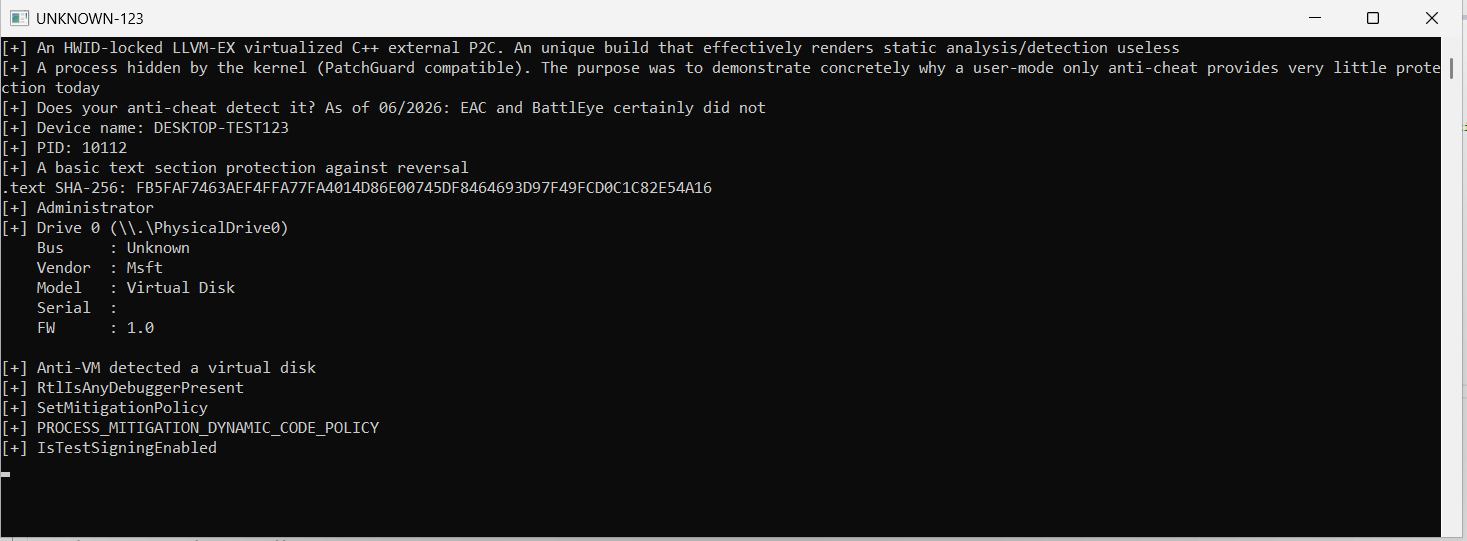
First of all, my kernel-level implementation creates an almost impenetrable barrier, forcing most of cheats to operate strictly in user mode.
This is extremely difficult to bypass, even for a seasoned professional. As the lead developer of an anti-malware I know exactly what I am talking about.
The concept, as well as the kernel‑level driver code I have validated for long‑term stability, has been ready for years. The concept and implementation details are protected under an NDA. I can provide a conceptual overview for a 4,999€ BTC upfront payment, once the agreement is acknowledged from the anti-cheat lead or CEO@yourcompany.com email address. This information and any associated source code shall not be disclosed, distributed, or otherwise made available to any third party under any circumstances.
I've have built a kernel‑level anti‑cheat system that detects more cheaters than EAC, BattlEye, ACE, XIGNCODE3 combined. And yes I can back up my claim at any time.
The core capabilities of this solution are already fully implemented, making it dramatically more cost‑efficient to maintain.
Its operational overhead is only a fraction of what any of these four mainstream providers require — several times cheaper to run while delivering stronger detection performance.
Shutting cheat development down at its source
When combined with the allowlisting mechanism demonstrated in my video, developing or running cheat tools while the game process is active becomes extremely difficult. As you saw, by default nothing non‑Microsoft signed launches — and even private, internal development tools fail to start. The same core principles that render advanced malware ineffective also power this anti‑cheat's ability to shut down cheat development at its source. In addition, no user‑mode cheat designed for the game is able to start at all. At the very least, this raises the bar, making cheating in the game harder than ever before. Of course, the list of allowed programs is fully configurable by the game developers. As a result, the cheater is effectively forced toward a DMA‑based approach, since every conventional user‑mode method is blocked at the start.
Why user-mode anti-cheat is not sufficient
A process list obtained from user mode is not sufficient for this, since we assume that any potential cheat software (P2C) may already be present in the kernel before the anti‑cheat initializes. There are three scenarios: the cheat may run as a visible process, as a hidden process, or by injecting itself into a benign process. A fourth possibility is process hollowing, where a legitimate process is started in a suspended state and its code is replaced with malicious payload. Injecting directly into the game process introduces additional detection vectors, but even this is blocked when cheaters are restricted to user mode. Keeping the design as simple as necessary ensures the codebase remains maintainable.
If the anti‑cheat does not operate at the kernel level, it cannot reliably detect even a virtual machine, which in turn gives a banned player endless opportunities to keep ruining other players games.
At the very least, developing P2C cheats remains safe without risking an HWID ban. A user‑mode anti‑cheat cannot detect a single HWID spoofer either.
A user-mode anti-cheat operates at the lowest privilege level in the Windows architecture. It runs in the same environment as normal applications, which means it must follow the same rules and restrictions as the software it is trying to monitor. Modern cheat developers take advantage of this limitation, making user-mode anti-cheat solutions fundamentally inadequate for today's threat landscape.
1. User-mode cannot see kernel-level activity
If a cheat runs in kernel mode, a user-mode anti-cheat cannot detect it. Kernel drivers can hide processes, manipulate memory, bypass security checks, and interfere with system behavior in ways that user-mode software cannot observe or prevent.
2. User-mode can be tampered with or disabled
Because user-mode anti-cheat runs like any other application, attackers can inject code into it, hook its API calls, block its memory reads, spoof its results, or terminate the process entirely. It cannot reliably protect itself from manipulation.
3. User-mode cannot enforce execution control
User-mode software cannot prevent unauthorized code from running. It cannot block DLL injection, stop unsigned drivers, enforce code-signing policies, or implement a true zero-trust execution model. It can only request information, not enforce security boundaries.
4. User-mode cannot implement reliable zero-trust security
Zero-trust execution requires strict allowlisting at the process and application level, validation of drivers, protection of memory regions, and enforcement of what code is allowed to run. These capabilities require kernel-level control and cannot be implemented from user mode.
5. User-mode cannot detect hardware-assisted or virtualization-based cheats
Modern cheats use techniques such as DMA hardware, PCIe devices, hypervisors, and virtualization layers. These operate below the visibility of user-mode applications. A user-mode anti-cheat sees only what the operating system allows it to see, which can be manipulated or falsified.
Summary
A user-mode anti-cheat is not a security layer; it is an attack surface. It cannot see kernel-level cheats, cannot protect itself, cannot enforce execution rules, and cannot detect modern hardware-assisted or virtualization-based attacks. For these reasons, a modern anti-cheat must operate at the kernel level to provide meaningful protection.
The total price for this project is 49,999 € in BTC for a non‑exclusive license to the Windows kernel driver source code.
I recommend purchasing the full package with source code, as the implementation is quite straightforward. With any modern P2C, I can demonstrate that even one cheater is detected during a single game session while my solution is active.

If you have a company and your own legitimate EV code‑signing certificate, send me an email from your company address if you're interested in some kind of collaboration. Please also include your Telegram in the email. Thank you.
White Byte © 2026 HEXDEREF.COM - DO NOT REPRODUCE CONTENT WITHOUT PERMISSION